Water Meter Moving When Everything Is Off?
Your water meter shows flow even though the faucets, showers and appliances are off. Before assuming a pipe is leaking, check whether the meter is recording water used by an automatic system. A moving meter shows flow; it cannot identify where that water went.
The Town of Queen Creek publishes specific instructions for its Sensus iPERL water meters. If your property is served by a different water company, identify your meter model and follow that provider’s directions instead.
Find the meter reading and flow indicator
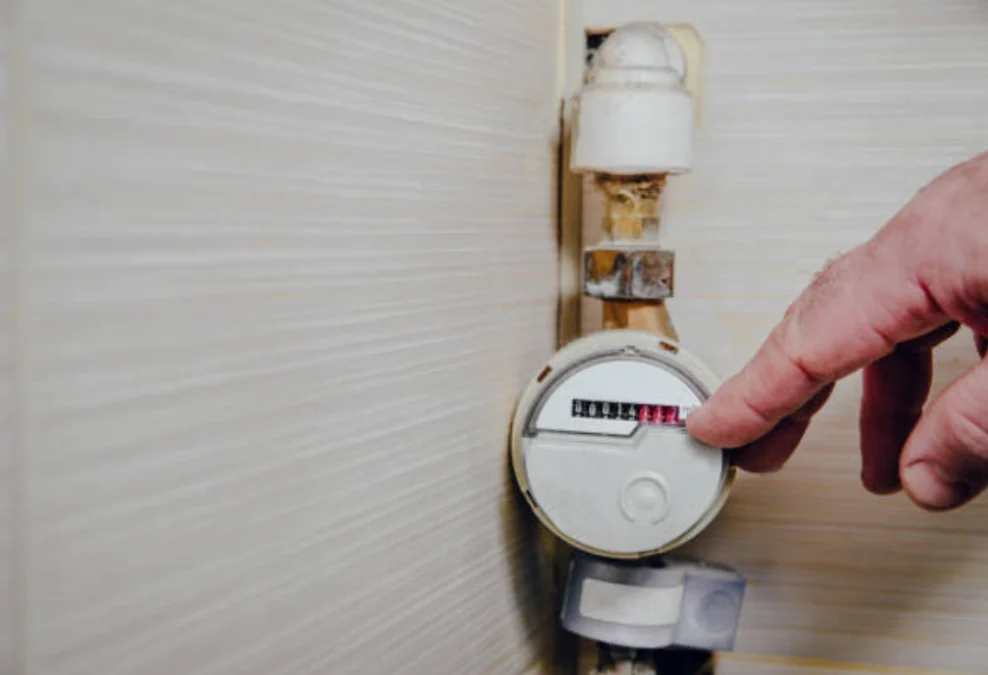
The Town’s Home Water Leak Check explains that its Sensus iPERL meters display water usage in gallons. For that meter, the numbers after the decimal point show fractions of a gallon.
The Town also describes a plus sign inside a small circle next to “Gal” when water is passing through the meter. This is a flow indicator. It does not tell you whether the water is reaching a toilet, irrigation equipment, a pool fill line or damaged supply piping.
Check the provider first. Queen Creek addresses can receive water from different utilities. Use the company listed on your bill and its meter guidance. Do not remove a meter seal or operate utility-owned controls.
Perform the Town’s one-hour meter check
The purpose is to compare two readings during a period when no water should be used.
- Stop intentional water use. Make sure nobody is showering, flushing a toilet, washing clothes, watering the yard or filling a pool. Account for equipment that runs automatically.
- Record the first reading. Write down the complete visible meter reading and time. A clear photograph is helpful.
- Wait at least one hour. Nobody should deliberately use water during the observation. Note any system that starts on its own.
- Record the second reading. Subtract the first reading from the second. A higher reading means water moved through the meter during the test.
For example, if the display changes from 5,613.20 to 5,615.20 gallons, the difference is 2 gallons. The number tells you how much water passed the meter during that interval, not where it went.
How to interpret the result
| What you observe | What you can conclude |
|---|---|
| Flow indicator appears while a faucet is running | Water is passing through the meter as expected. |
| Reading increases while no water use was intended | Something used water during the test. Check automatic equipment and possible leaks. |
| Reading does not change over one hour | No measurable use was recorded during that interval. Intermittent problems remain possible. |
| Reading rises repeatedly in controlled checks | Further isolation or professional investigation is reasonable if no known use explains it. |
A toilet that refills every few hours, a stuck irrigation valve that runs during a scheduled cycle or a pool autofill can escape a test taken at another time. When symptoms are intermittent, keep a log and repeat the observation during the suspected period.
Can a house shutoff help narrow the source?
In its published procedure, the Town describes a house water shutoff commonly located on the supply riser near the front of the home, often near a hose bib. Whether that valve isolates your indoor plumbing, an outdoor branch or both depends on the property’s piping arrangement.
If the flow stops after closing the correct house valve
The use is likely downstream of that valve. This can include indoor fixtures and any pool or outdoor system fed through the home’s plumbing. It is not proof that a leak is behind a wall or beneath the slab.
If flow continues after the house is isolated
Water may be passing through another branch, including landscape irrigation. The Town describes using the irrigation shutoff, where appropriate, to help distinguish that water use. Continued unexplained flow after properly isolating known branches may suggest an issue in supply piping between the meter and the shutoffs.
Only operate a familiar, safe homeowner shutoff. The Town warns that old valves and fittings can become brittle or corroded. Do not force a valve, disturb the meter or attempt to isolate unfamiliar piping. A plumber or the water provider can help identify which valve controls each section.
Why a reading on the bill may look different
Account records describe a completed billing period, while the meter display shows a reading at the time you look at it. The Town’s water FAQ also explains that the meter reading shown for billing can be rounded down to the nearest 1,000 gallons. Compare the correct dates and billing usage, rather than assuming two readings taken at different times should match.
If a meter reading or billed amount looks wrong, contact the water provider. A utility billing question and a plumbing leak investigation require different checks.
What evidence should you keep?
- The first and second complete meter readings.
- The date and exact time of both observations.
- Whether the flow indicator was visible.
- Which fixtures, irrigation stations, pool equipment and water treatment systems were off or on.
- Whether the issue occurs continuously or only at particular times.
- Visible water damage or unusual pipe sounds, if present.
These records help isolate the source of unexplained water use without treating a moving meter as proof that a particular pipe needs repair.
When the meter keeps showing unexplained use
If you have ruled out ordinary equipment cycles and repeated checks still show consumption, household plumbing may need assessment. Creekline Plumbing’s leak detection service in Queen Creek explains the next step for suspected concealed or supply-line water loss.
Frequently asked questions
Does a plus sign on a Sensus iPERL meter always mean a leak?
No. The Town’s meter indicator shows water passing through it. Normal fixture or automatic equipment use can create flow.
How long should I wait between readings?
For the Town’s home leak check, at least one hour with intentional water use stopped. Follow another provider’s instructions if it supplies your address.
Can a meter confirm a slab leak?
No. A meter can record water passing through it, but locating the water loss requires additional investigation.
Should I use the valve next to the meter?
Do not operate utility-owned equipment or an unfamiliar valve. Use only a clearly identified homeowner shutoff that operates safely, or ask the water provider or a plumber for help.
Official references: Town Home Water Leak Check; Local Water Providers; Town Water FAQ.