
Whole-House Water Filtration
Queen Creek, AZ
Sediment coming from several faucets, an unusual taste, or a persistent odor can raise concerns about the water throughout your home. Different water problems require different types of filtration.
Whole-house water filtration treats incoming water before it reaches your faucets and fixtures. Checking the water supply and testing when needed helps select a system suited to the specific issue.
Water concerns at more than one tap? Start with the source.
A taste or odor throughout the home. Fine particles in the water. Or a plan to install filtration before water reaches the faucets and showers. Those are different reasons to consider a whole-house water filter—and they do not all call for the same equipment.
Whole-house filtration in Queen Creek treats water at a selected point on the incoming supply, often called point-of-entry (POE) filtration. A practical system needs enough flow for the household, space for future cartridge or media service, and treatment media matched to a specific concern.
The starting point is simple: identify what the water needs to be treated for, then verify which filter can perform that job. A sediment filter, activated-carbon system and water softener should not be treated as interchangeable products.
Sediment at multiple fixtures
Suspended particles can support a sediment-filtration discussion. Dissolved minerals require a different treatment decision.
Unwanted taste or odor
Activated carbon may be appropriate for some concerns; the product’s exact tested claims are more useful than “premium filtration” marketing.
A specific water-quality concern
Review your water provider’s report and suitable testing first. Select treatment only for a contaminant or outcome the system is documented to address.
Whole-house water filter installation in Queen Creek, AZ
Water filter installation in Queen Creek begins at the plumbing, not at a product catalog. A plumber should determine which line supplies the house, where the filter can be accessed, and what changes are needed for a secure installation.
- Connection location and treated lines Identify the accessible incoming water line and which fixtures the selected placement will serve. Not every exterior line or irrigation branch should automatically pass through a filter.
- Shutoff valves, bypass and unions Plan how the unit can be isolated for service and whether a bypass and removable connections are appropriate to the manufacturer’s design.
- Pressure drop and peak household flow Match the equipment’s rated service flow to simultaneous showers, faucets and other demand. A restrictive or clogged filter can affect delivery at fixtures.
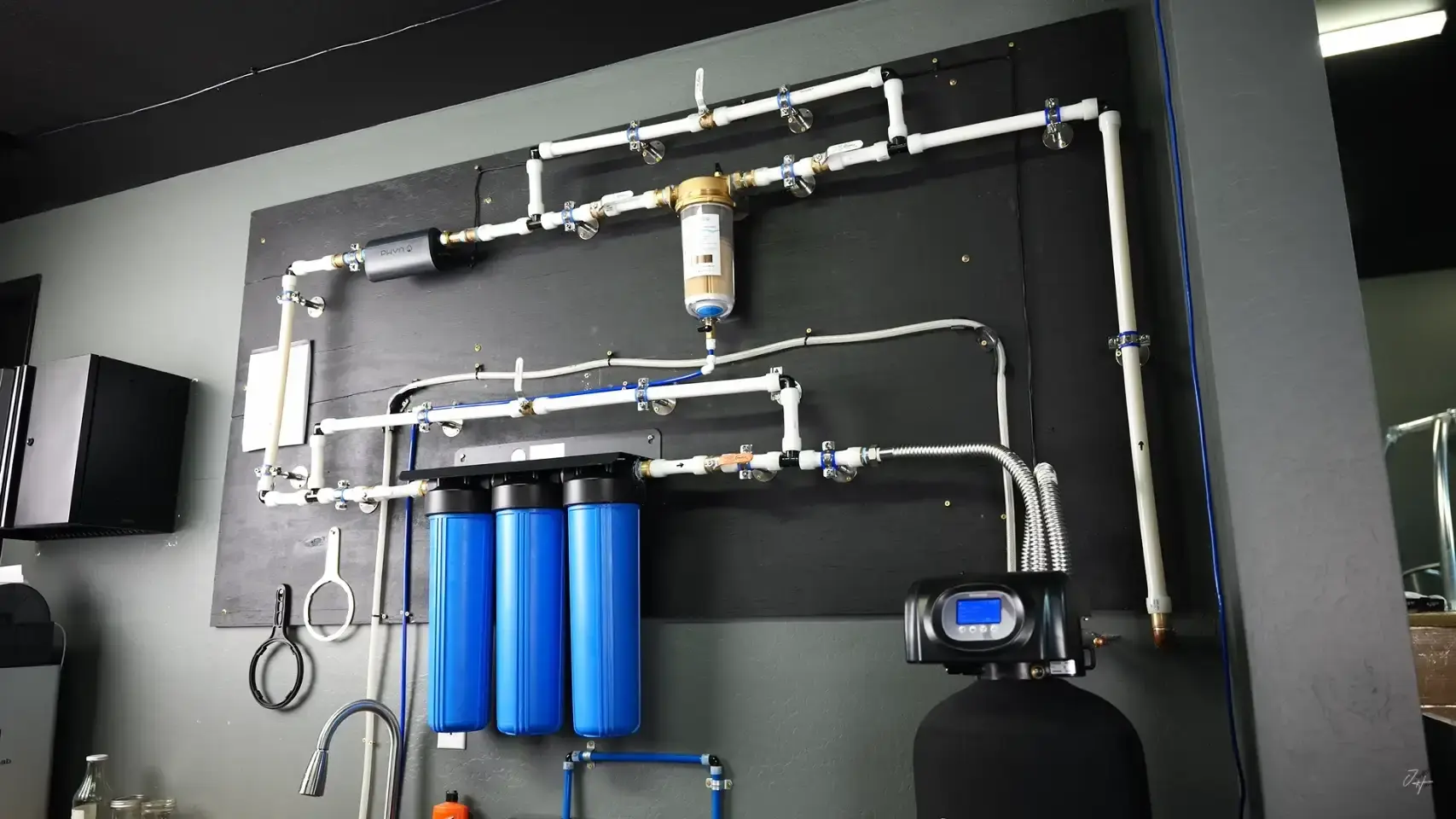
- Housing, drain, power and clearance Allow for filter changes, wall clearance, safe access and model-specific needs such as backwash drainage or power.
For Arizona installations, equipment exposure to outdoor heat and sunlight also deserves attention. The selected housing and its location need to meet the manufacturer’s environmental limits, rather than assuming any filter can be mounted outdoors.
Which filter actually matches the water problem?
Different treatment media serve different purposes. This comparison is a starting point; the performance data sheet and certification record for the exact model determine what can be claimed.
| Equipment | What it may help address | What it does not automatically solve |
|---|---|---|
| Sediment cartridge or prefilter | Certain suspended particles, depending on filtration rating and water conditions; may also protect downstream treatment equipment. | Dissolved calcium and magnesium hardness, dissolved chemicals, or pathogens without an appropriate validated claim. |
| Activated-carbon filtration | Selected taste, odor and disinfectant-related concerns; certified contaminant reductions differ by product. | Every chemical, hardness minerals, or all microbial risks simply because the media contains carbon. |
| Multi-stage / media-tank treatment | Specific combinations of concerns when each stage is chosen for a documented function and adequate service flow. | Universal “purification.” Extra stages alone do not prove better water quality or certified contaminant reduction. |
Look beyond the NSF number. NSF/ANSI 42 covers aesthetic reduction claims; NSF/ANSI 53 covers particular health-related reduction claims. A product must be verified for the specific substance it is advertised to reduce. See NSF’s standards guide and CDC filter-selection guidance.
Whole-house filtration is not the same as water softening
These systems can be installed in the same home, but they answer different questions. Distinguishing them before buying helps avoid paying for a system that cannot deliver the outcome you want.
Whole-house water filtration
Point-of-entry treatment intended to reduce selected particles, taste and odor concerns, or other specifically verified substances across the supplied fixtures. This page covers that installation.
Water softening
Ion-exchange softeners reduce calcium and magnesium hardness that contributes to scale. For hard-water deposits and softener maintenance, use Water Softener Installation & Service.
Under-sink drinking-water treatment
Point-of-use filtration serves a particular drinking or cooking tap. It can be a better fit when the concern is limited to one outlet rather than every shower and fixture.
A standard sediment or carbon filter should not be sold as a substitute for a water softener. Likewise, a softener does not prove removal of microbes or an untested contaminant.
Queen Creek water reports and what they mean for your home
A Queen Creek, AZ 85142 address does not establish the same water supplier or identical water quality for every property. Check the name on your utility bill and start with that supplier’s current Consumer Confidence Report (CCR), which summarizes regulated drinking-water testing.
Town-served water meets reported standards
The Town of Queen Creek’s 2025 Annual Water Quality Report reported no health-based violations among regulated substances tested. That does not mean every household needs filtration—or that an issue inside a home’s pipes is reflected in the utility report.
Different providers, different reports
The Town identifies multiple water providers in the Queen Creek area. A provider report is a baseline; a specific change in taste, color or odor at one fixture may require investigation of that fixture or the home’s plumbing.
Hardness is a different decision
For its own system the Town reports 6–17 grains per gallon of water hardness. That number is useful when evaluating a softener, but it is not evidence that a whole-house sediment or carbon filter will remove calcium and magnesium.
Testing before contaminant claims
If the concern involves a particular chemical or microorganism, identify the water source and use appropriate reliable testing. Then compare exact certified product claims; do not assume that a clear-looking glass of water proves safety or that a filter removes every substance.
Cartridge filter or media tank? Match capacity to the plumbing.
A cartridge housing can be practical for a defined sediment problem, provided it has enough flow and space to change the element. A larger media system may fit a different treatment goal or water demand, but could require backwashing, drainage, power or added clearance.
For either option, review the service-flow rating, pressure-loss data, housing pressure limits, replacement or backwash schedule, shutoff arrangement and compatibility with existing treatment equipment.
If a water softener is already installed, the sequence of filtration and softening depends on the actual product instructions and the water concern. There is no reliable one-size-fits-all plumbing order for every system.
Useful buying check: Ask for the model number and performance data sheet, not just a brand or promise of “cleaner water.” Verify the specific treatment claim and the expected cost of replacement media before approving installation.
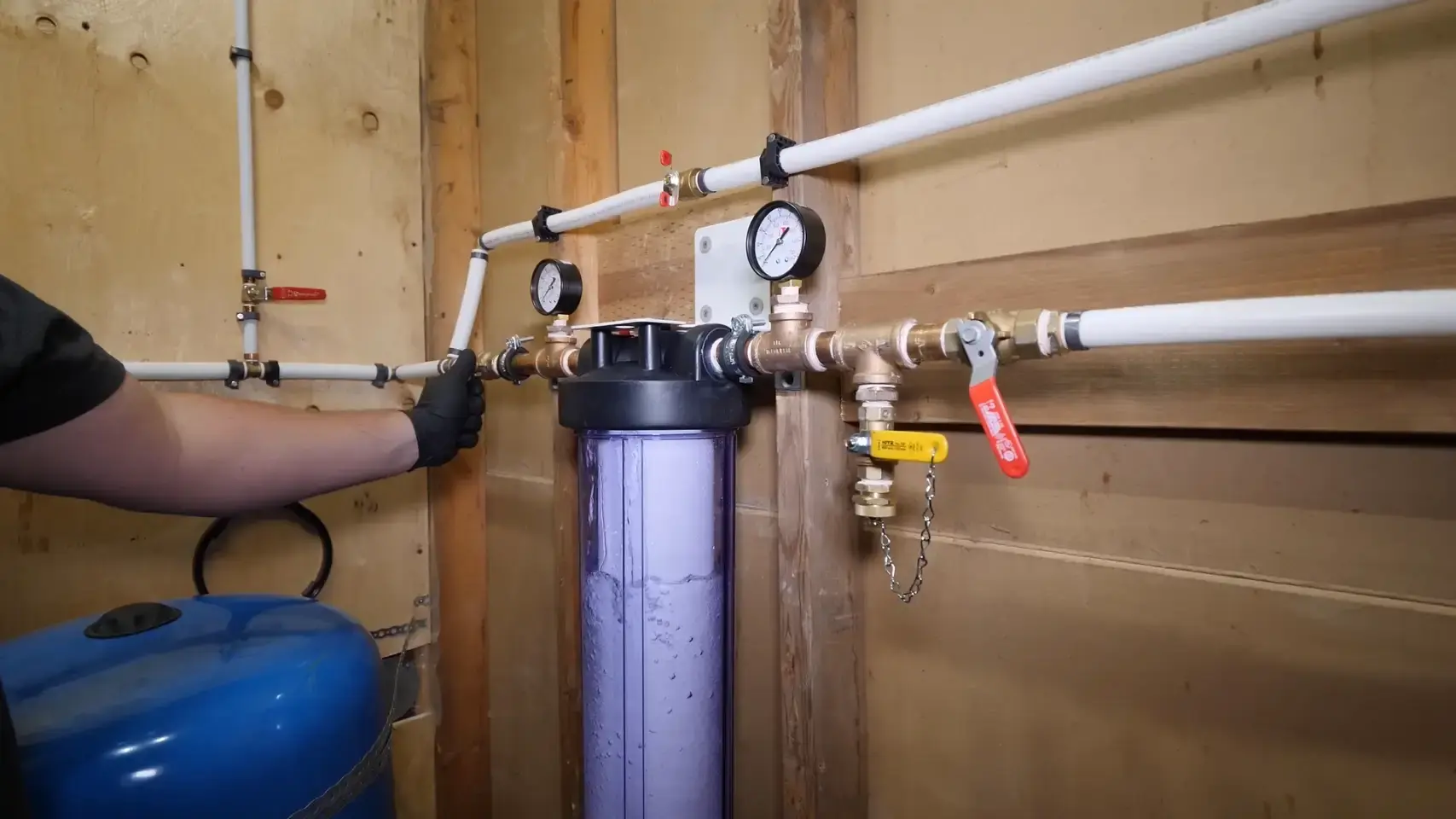
From water concern to installed filtration system
The installation should follow a specific treatment objective and an agreed plumbing scope—not a universal “whole-home purification” package.
- Identify what needs to change. Discuss the water provider, which fixtures are affected, existing equipment, useful test results and the desired outcome.
- Review the equipment and water line. Compare certified product claims, inlet flow, service access, pipe connections, available space and possible pressure effects.
- Confirm the complete installation scope. Identify the proposed model, valves, bypass, placement, any needed drain or power, and which finishing or permit responsibilities apply, if any.
- Install and check the result. Inspect connections for leaks, confirm normal flow and operation according to the product, and explain filter changes, isolation and warranty documentation.
Filter maintenance is part of the installation decision
Whole-house filtration needs planned upkeep. Cartridge changes, sediment loading, media replacement and the water entering the unit affect how the system performs over time. A clogged filter can cause a drop in pressure; a neglected filter may no longer deliver its intended treatment.
- Replacement intervals Follow the actual manufacturer’s schedule and any capacity or pressure-drop guidance, not a generic annual change date.
- Isolation and bypass Understand where the shutoffs are and how servicing is carried out without damaging the housing.
- Downstream disinfectant implications A whole-home system that removes chlorine or similar disinfectants can allow more microbial growth in plumbing if not correctly selected and maintained.
- Product-specific verification If the goal is reduction of a particular substance, review the exact certification and any recommended post-installation checks.
The CDC recommends following manufacturer maintenance instructions and cautions that whole-home disinfectant removal can affect microbial growth within household plumbing.
What affects whole-house filtration installation cost in Queen Creek?
A filter housing alone is not the whole project. The price depends on which equipment is appropriate and what work is needed to connect it correctly to the home.
- Treatment equipment Filter housing, media type, rated flow, specific certified claims and any additional stages justified by the water conditions.
- Plumbing changes Accessible supply line, pipe material, fitting transitions, shutoffs, unions, bypass and appropriate mounting.
- Site conditions Indoor or protected placement, space to service the unit, water pressure, required drain or electrical support.
- Ownership cost Replacement cartridges or media, backwash needs, maintenance labor and any recommended verification testing.
Before authorizing work: Confirm the exact model, claimed treatment result, what is included in the installation, and who is responsible for future filter changes. A written scope is more useful than an unsupported fixed-price promise.
Whole-house filtration questions from Queen Creek homeowners
What is the difference between whole-house and under-sink filtration?
A whole-house or point-of-entry system treats water before it reaches multiple fixtures. An under-sink or point-of-use system serves a particular tap. The better choice depends on whether the concern affects the entire home or just drinking and cooking water.
Will a whole-house water filter soften hard water?
Not automatically. Standard sediment and activated-carbon filtration do not remove dissolved calcium and magnesium in the way an ion-exchange water softener does. Choose equipment according to the actual treatment goal.
Does my Queen Creek home need a water filter if the utility water meets standards?
Not necessarily. The Town’s 2025 report found no health-based violations among regulated substances tested. A household might still seek treatment for a defined taste, odor, sediment or independently verified concern. Confirm your actual water provider and the product’s claims before buying.
Can a whole-house filter improve chlorine taste or odor?
Some appropriately sized carbon systems have verified chlorine taste-and-odor reduction claims. Check the exact product and certification. Removing disinfectant throughout the home also has maintenance and downstream plumbing implications.
Do NSF/ANSI 42 and 53 mean a filter removes every contaminant?
No. NSF/ANSI 42 relates to specific aesthetic claims and NSF/ANSI 53 to specific health-related reduction claims. A model’s listing or performance sheet must identify the particular substance and reduction claim.
Will the filtration system lower shower pressure?
It can if the system is undersized, the media is restrictive, or a cartridge becomes clogged. Compare rated service flow, expected pressure loss and household peak water use before installation.
Can whole-house filtration be installed alongside an existing water softener?
Often yes, if the plumbing layout, water conditions and selected equipment allow it. The placement order and bypass arrangement depend on the exact models rather than one universal sequence.
Does a filter remove bacteria, viruses, lead or PFAS?
Not as a blanket claim. Reduction depends on the filter technology and its specific certified performance. If one of those is the concern, identify the substance and choose equipment verified for that specific use rather than relying on “whole-house filter” branding.
How often should whole-house cartridges or media be replaced?
Intervals depend on the model, water conditions, water use and manufacturer instructions. Some systems require cartridge replacement; others use media tanks with different service procedures. Monitor any indicated pressure drop or change in performance.
Can I use a filter I purchased myself?
Provide its brand, exact model number, performance data sheet and installation instructions for evaluation. The installer needs to check rated flow, connection dimensions, approved location and required service clearances before confirming compatibility.
What should I ask before scheduling installation?
Ask which concern the proposed system will address, the specific certified product claims, what plumbing and bypass work are included, how much service flow it supports, and the ongoing maintenance requirements. Also confirm any separate testing or repair work.
Plan filtration around your home’s actual water concern
Considering a whole-house water filter in Queen Creek, AZ 85142? Describe what you notice, which water provider serves your home and whether the concern affects multiple fixtures. Creekline Plumbing can discuss the point-of-entry installation scope and the questions to resolve before equipment is selected.
Call (480) 741-9220